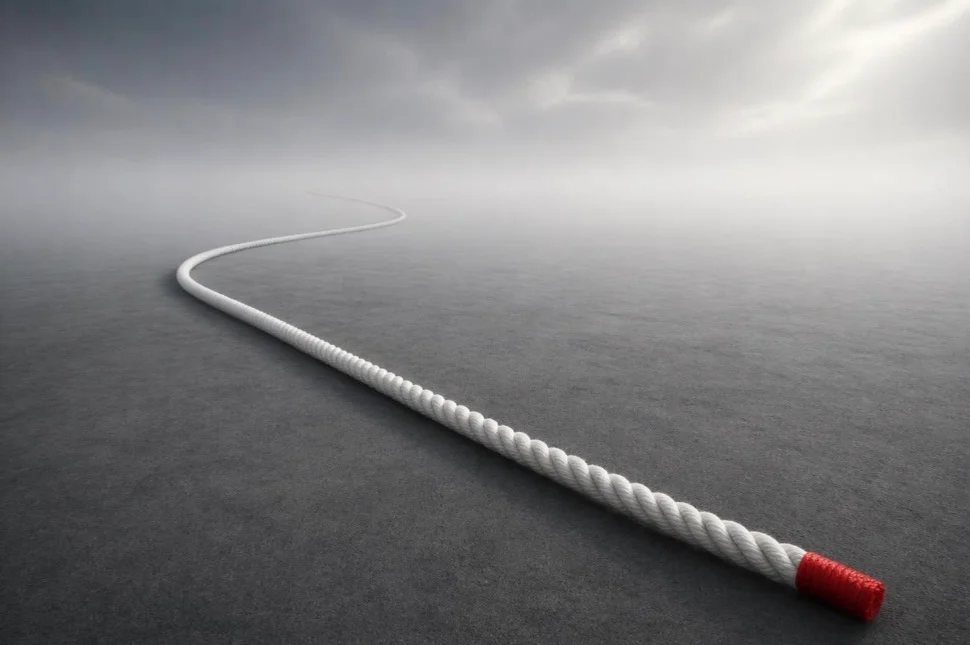
There is an image I keep returning to. A thick white rope lies on a grey floor, beneath a grey sky filled with fog. The end nearest to us is bound and marked in red — short and finite. But as the rope travels away, it thins, curves once, and then loses itself in the mist. We cannot see where it ends. As far as the eye can follow, it simply keeps going. This image reminds me of life seen in the light of eternity — of how finite our human existence is within this universe, and of the eternity that lies beyond it. The hardships, the troubles, the broken conditions we endure in this imperfect world are only temporary, for there is an eternity awaiting us beyond this span of life.
This image has kept me company these past weeks, because the news from my country has weighed heavily on me.
When the numbers fall
The rupiah recently touched a record low — near Rp 18,200 to the dollar (now still around Rp. 18,000), weaker than it has ever been, weaker even than during the Asian Financial Crisis that older Indonesians still remember in their bones. The IHSG, our composite index, has fallen more than a third from its peak, making Jakarta one of the worst-performing stock markets in the world this year. Foreign money has been leaving. Analysts use words like doom-loop. Credit agencies have turned their outlook negative.
And underneath the numbers sits a quieter grief: the sense that decisions are being made without enough wisdom, that policies are launched with great confidence and little foresight, that those who carry the weight — ordinary families, small traders, the young — are the ones who absorb the cost. It is easy, in a season like this, to feel that the people steering the ship are looking everywhere except at the rocks.
I will not pretend I have not felt the anger. To love a place is to grieve when it is governed poorly. The prophet Jeremiah felt it too. He is called the weeping prophet for a reason. He watched leaders make ruinous choices, watched a nation he loved slide toward catastrophe, and he wept. So if you are weeping a little this week, you are in honest, holy company.
A letter into the dark
But here is what struck me. The most famous words of comfort in the whole Bible were not written in a season of prosperity. They were written into an exile.
**For I know the plans I have for you, declares the LORD, plans to prosper you and not to harm you, plans to give you a hope and a future.” ** — Jeremiah 29:11
We love to quote this verse over graduations and weddings, printed on mugs and pillows. But its original setting is brutal. Jerusalem had fallen. The temple was gone. The best and brightest had been dragged a thousand kilometres to Babylon, to live under a foreign empire whose policies they could not vote on and whose king they did not choose. The economy they had known was rubble. Everything that had felt permanent had proven fragile.
It was to those people — disoriented, displaced, furious, afraid — that God sent a letter through Jeremiah. And the letter did not say, “Hold on, this will be over by next quarter.” It said the opposite: “Settle in. Build houses. Plant gardens. Marry, and have children, and let your children have children” (Jeremiah 29:5–6). The exile would last seventy years (Jeremiah 29:10) — longer than most of them would live. And then, God said, I know the plans I have for you.
The hope was real. But it was not a hope that the bad season would be short. It was a hope anchored in a God whose horizon is longer than ours.
The red tip and the rope
This is where the rope comes back to me.
The red-bound end — the part we can see clearly, measure, and hold — is our life on earth. Eighty years, perhaps. Long enough to feel like everything. Long enough that a falling rupiah and a falling index can feel like the whole story.
But the rope does not end at the red tip. It runs on, past the curve, into the mist, beyond where the eye can follow — and it does not stop. That is eternity. That is the life that has no end, the life Jesus opened for us, the part of the rope that makes the red tip what it truly is: not the whole rope, but the smallest beginning of it.
Henri Nouwen once described faith as the trust of a trapeze artist — the courage to let go of one bar before the next one is in your hands, believing you will be caught. An eternal perspective is not denial. It does not pretend the markets are fine or the leadership is wise. It simply refuses to let the red tip pass itself off as the entire rope. It says: this season is real, and it is grievous.
When you see the rope whole, the dollar exchange rate does not stop mattering — but it stops being able to crush you.
The dawn hidden inside the exile
There is one more thing in Jeremiah I do not want you to miss, because it is the seed of all the hope.
Even as he announced seventy years of darkness, Jeremiah was already speaking of a dawn. In the same season he prophesied that God would raise up a righteous Branch for David — a coming King who would reign with justice and righteousness, whose name would be The LORD Our Righteousness (Jeremiah 23:5–6; 33:14–16). And history bent toward it: the exile did end. A new leader, Cyrus, arose and sent the people home. The temple was rebuilt. The line of David was kept alive in Babylon’s shadow — and from that preserved line, centuries later, came Jesus.
Notice the pattern. God’s deliverance was already being prepared inside the very exile that looked like the end. The dawn was germinating in the dark. The new leader was being raised up while the old order was still collapsing.
I find this almost unbearably hopeful. It means that in the worst seasons of a nation, God is not absent and waiting — God is working now, quietly, underground, raising up what we cannot yet see.
What my daughter showed me
And then, this week, God gave me a small confirmation I did not ask for.
I watched my daughter graduate from kindergarten.
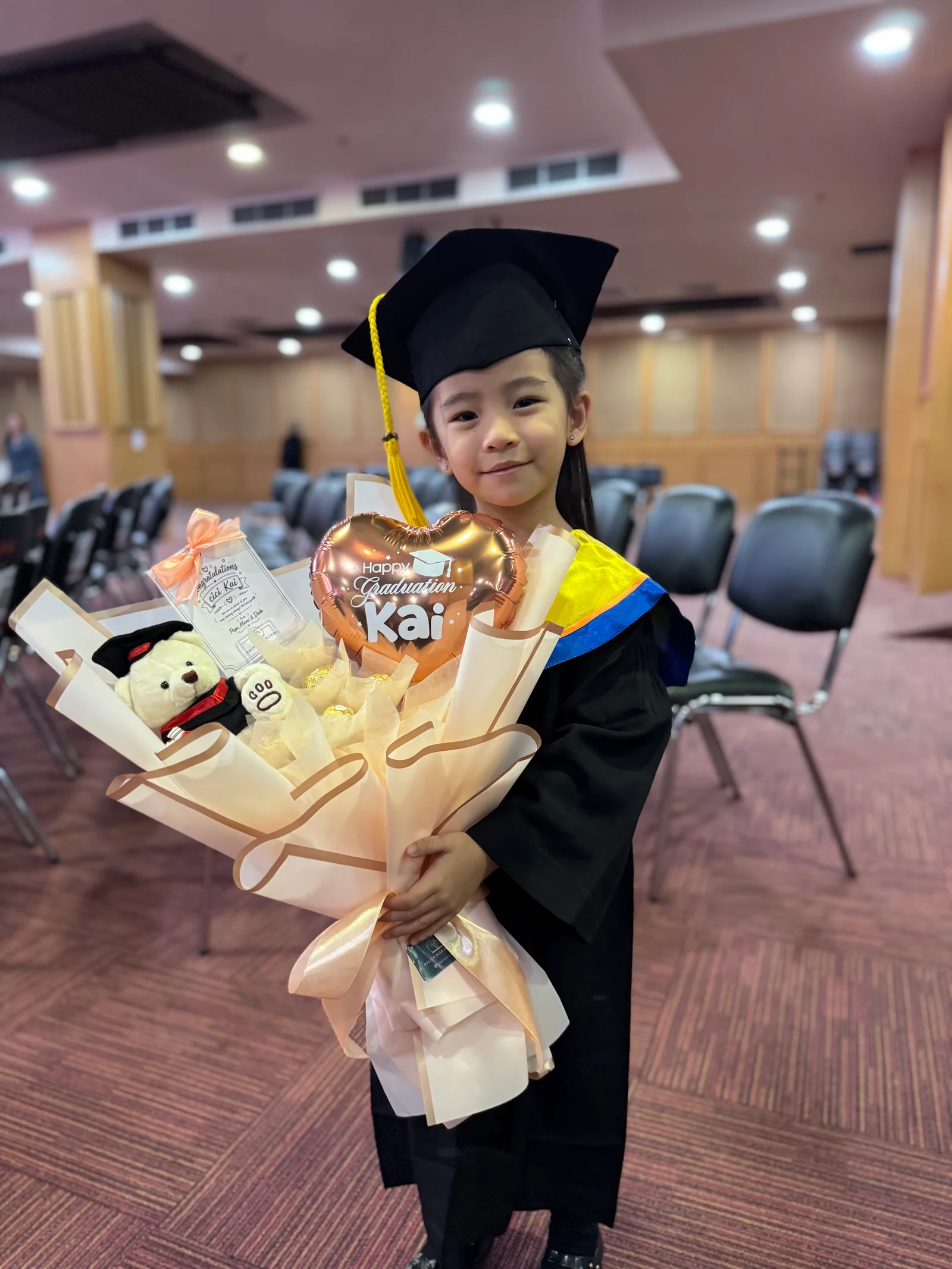
It is a tiny thing, in the scheme of headlines. A little procession, a paper certificate, a song sung slightly off-key, a room full of parents trying not to cry. But I sat there and felt the Spirit press something into me with great gentleness:
A new generation is coming.
While the markets fell, these children were learning to read. While the currency weakened, they were learning to share, to sing, to forgive a friend on the playground. The very thing God told the exiles to do — **have children; let them grow; build a future even here **— was happening in front of me.
The next generation is not a someday. It is already in the room. It is already graduating. God is not merely promising a future; God is raising it up now, in small chairs, in small hands, in children who do not yet know how heavy this year felt to the adults around them.
That is the dawn inside the exile. That is Jeremiah 29:11 with a face I tucked into bed that night.
So here is where I have landed, and where I want to leave you.
I am not asking you to feel cheerful about the rupiah, or to make peace with poor decisions, or to pretend the cost falling on ordinary families is acceptable. Lament is faithful. Keep grieving honestly as Jeremiah did.
But hold on to the hope. God is raising up a dawn we cannot yet see. Sometimes He lets us catch a glimpse of it. Sometimes the glimpse is wearing a paper graduation cap.
Build your house. Plant your garden. Raise your children. Pray for our city and nation. And lift your eyes past the red tip, to eternity. God already knows the future.
For I know the plans I have for you.