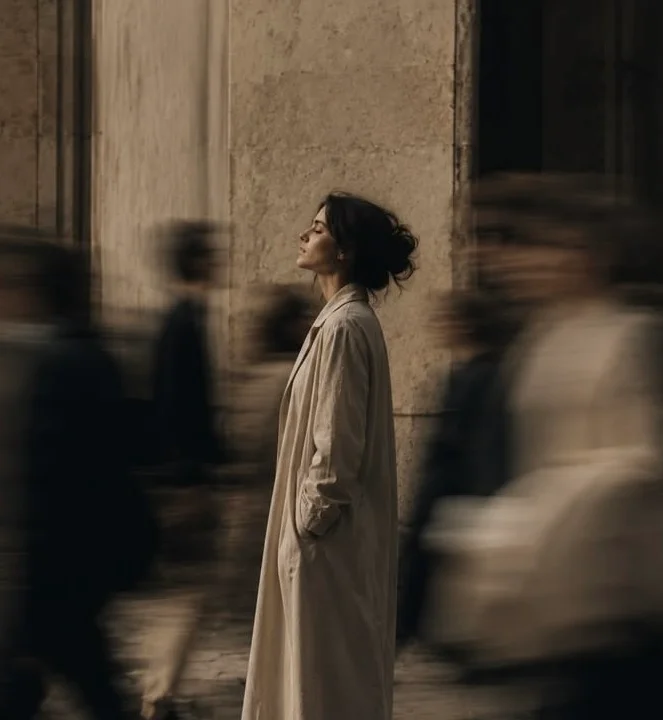
A Question for a Noisy World
Most of us live with a phone within arm's reach. We wake up to notifications and fall asleep scrolling. Our minds jump from one thing to the next like a monkey swinging between branches. Even our prayers can become a kind of busy talking: a list of requests, a quick "thank you," and then back to the rush.
Somewhere underneath all that noise, many of us feel a quiet hunger. We want something deeper, but we're not sure what it is or where to find it.
For centuries, Christians have had a word for what that hunger is reaching toward: contemplation.
It sounds like a big, old-fashioned word, something only monks in faraway monasteries do. But contemplation is actually very simple. It is for teachers and teenagers, parents and students, busy workers and retired grandparents. It is for anyone who wants to listen for God and_ be with_ God, not only _talk about _God, at God and to God.
Contemplation Is Simply Being Awake
Thomas Merton, the Trappist monk whose writing introduced millions of ordinary people to contemplative prayer, opens one of his best-known books with this definition:
"Contemplation is life itself, fully awake, fully active, fully aware that it is alive." — Thomas Merton, New Seeds of Contemplation (1961)
Notice what Merton does not say. He doesn't say contemplation means escaping life or floating off into strange spiritual experiences. He says it is life itself, fully awake.
Think of the difference between eating a meal while staring at a screen, and eating slowly with a friend. It's the same meal. But in the first case, you're barely there. Contemplation is learning to be there: present to God, to yourself, to other people, and to the moment you are living in.
The Jesuit theologian Walter Burghardt gave a definition that Franciscan friar Richard Rohr loves to repeat:
A long, loving look at the real." — Walter Burghardt, SJ
Not a quick glance. Not a critical stare. A long, loving look at what is real: God, the world, and even our own messy hearts.
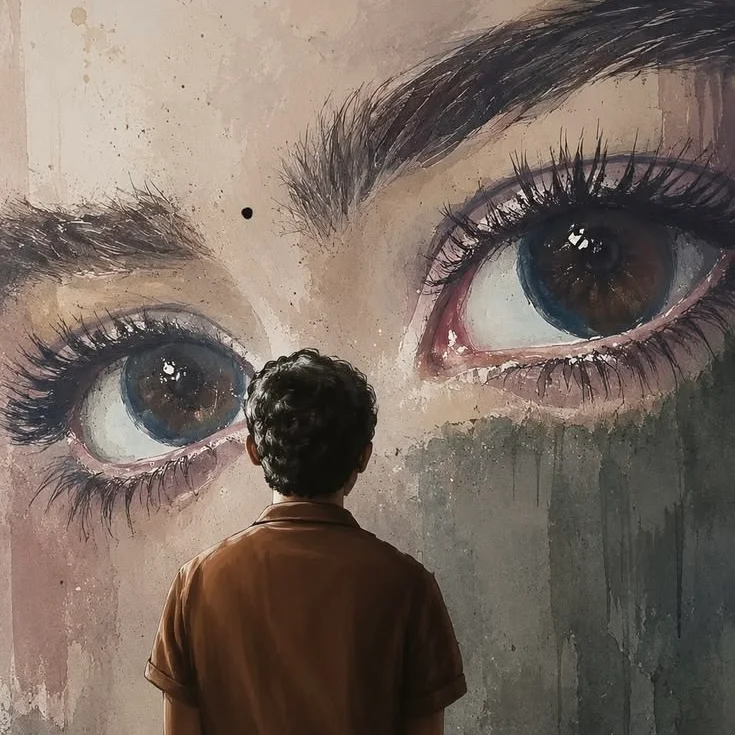
Is "Being Awake" the Same as Repentance?
If you grew up in an evangelical church, the word "awake" might remind you of something familiar: repentance, turning back to God. And yes, the two are closely connected.
When we put our faith in Jesus, God gives us the Holy Spirit. Paul writes that believers were "sealed with the promised Holy Spirit" (Ephesians 1:13). Jesus himself promised that the Father would give us "another Helper, to be with you forever" (John 14:16). The Greek word for Helper is paraklētos, the One who comes alongside us. The Spirit is the One who wakes us up to God in the first place.
But here is the honest truth: we don't stay awake very easily. Our attention drifts. Our hearts get pulled toward other things. That is why repentance is not a one-time event, but a daily return. Jesus said that whoever wants to follow him must "take up his cross daily" (Luke 9:23). Paul says that "our inner self is being renewed day by day" (2 Corinthians 4:16), and he urges us to "be transformed by the renewal of your mind" (Romans 12:2). He even calls out to sleepy believers: "Awake, O sleeper… and Christ will shine on you" (Ephesians 5:14).
So if conversion is the moment God first wakes us up, contemplation is the daily practice of being woken up again. It is how we cooperate with the Spirit, who keeps gently calling us back.
Seeing Through the Lens of Contemplation: The Son Who Came Home
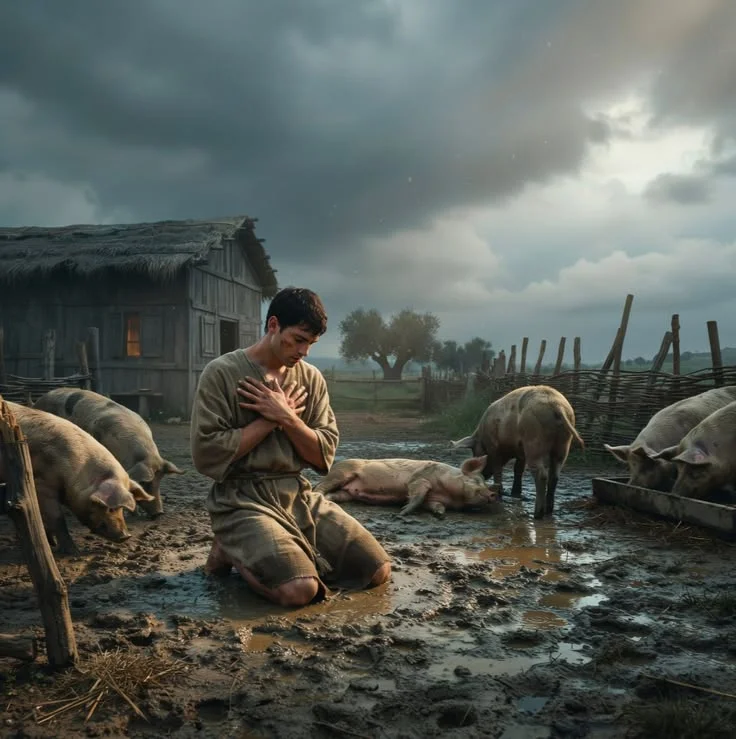
Jesus told a story that shows this beautifully: the parable of the prodigal son (Luke 15:11–32). The younger son's mind was taken over by greed and a desire to be free, completely free, with no one telling him what to do. He took his inheritance, left home, and spent it all. And if we are honest, he is not the only one. We too are often carried away by the same kind of thinking: If I just had more, if I were just free of every limit, I'd finally be happy.
But then something turns. Luke says the young man "came to himself" (Luke 15:17). He woke up. In the middle of the pig field, he finally saw clearly:
- who he really was — a son, not a slave to his hunger;
- who his father really was — generous, even to hired servants;
- what his father's house truly held — far more than he had ever realized;
- and what he had thrown away — the most precious thing of all.
This is exactly what contemplation does. The son was brought back to take a long, loving look at the real. And when he turned toward home, he discovered that his father had already been watching the road, running to meet him before he could finish his speech.
That is the heart of contemplation: we wake up, we look honestly, and we find that God has been waiting with open arms all along.
**Meister Eckhart **echoes this by saying:
God is at home, it is we who have gone out for a walk.
How Do We Get This Lens?
If contemplation is a way of seeing, how do we learn it?
Think about learning a new language. You can't become fluent by reading one article about grammar. You need to practice a little every day: listening, repeating, making mistakes, and slowly beginning to understand. One day, you realize you're thinking in that language without trying.
Contemplation works the same way. We need a spiritual discipline, and the discipline here is contemplative prayer. This is prayer that helps us rest and slow our lives down, so we can see clearly what is real in our lives, and how great God's love for us truly is.
It won't feel impressive at first. Your mind will wander, and that's okay. Each time you gently come back, you are practicing the very thing the prodigal son did: coming home.
Talking To God vs. Being With God
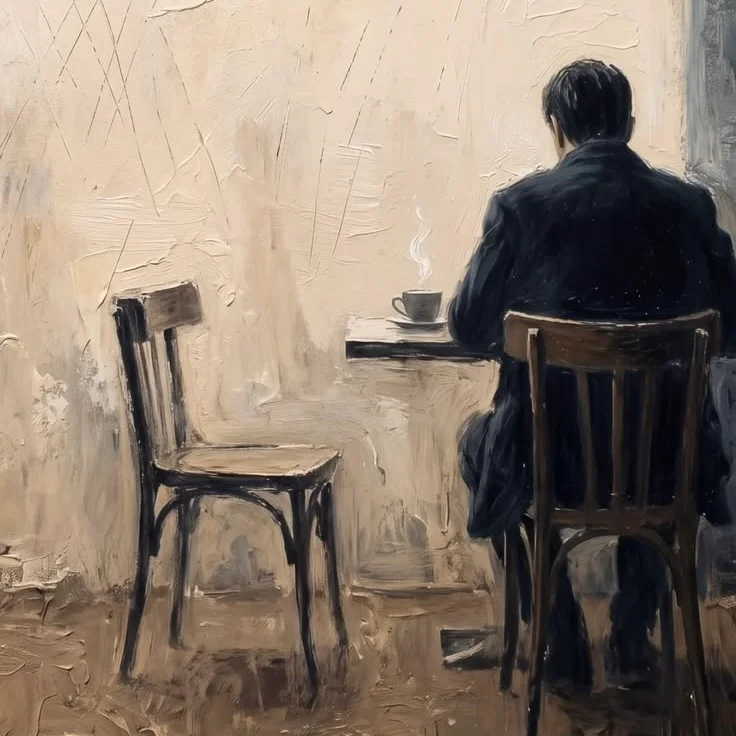
Picture a little girl at the end of a long day. She has chattered to her father: questions, stories, requests, one after another. But then she climbs into his lap, rests her head against his chest, and says nothing at all. He wraps his arms around her. Neither of them needs words. She is simply there, held, and that is enough.
Both moments are love. The chattering is good; a father delights in hearing his child's voice. But the quiet resting reveals something deeper: a trust so complete that words are no longer needed.
Prayer is like that. Most of us first learn to speak to God with words, and that is good and important. Contemplation is the quieter kind of prayer: resting with God beyond words. The psalmist knew this when he wrote, "I have calmed and quieted my soul, like a weaned child with its mother" (Psalm 131:2).
Thomas Merton describes contemplation as being "touched by God." It is a beautiful picture of an intimate relationship. The child on her father's lap doesn't earn the embrace or make it happen; she simply lets herself be held. Contemplation is the same. We don't try to produce a spiritual experience. We open ourselves, consent to God's presence, and let the One who loves us touch our heart.
Hurry: The Enemy of the Soul
If contemplation needs one thing more than anything else, it is a slower pace.
Dallas Willard was once asked by his friend John Ortberg what he needed to do to be spiritually healthy. Willard's answer was short and has become famous:
You must ruthlessly eliminate hurry from your life." — Dallas Willard
Willard knew that hurry is not just a scheduling problem. It is a spiritual problem. When we are always rushing, we can't love well, listen well, or notice God. Contemplation invites us to stop running, even for a few minutes a day. You don't need a monastery. You need a few quiet minutes and a willing heart to pause.
Contemplation Leads Back to Life
Some people worry that contemplation is selfish, a way to hide from the world's problems. The great contemplatives say the opposite.
Richard Rohr named his organization the Center for Action and Contemplationon purpose. He teaches that the two belong together: contemplation without action becomes self-absorbed, and action without contemplation burns out or turns bitter. Thomas Merton, from inside his monastery, wrote passionately about racism, war, and justice. Henri Nouwen, a beloved priest and writer, left a prestigious university career to live and serve among people with intellectual disabilities.
Even the prodigal son's homecoming didn't end in private. It ended in a feast, with music, dancing, and a family restored.
Contemplation doesn't take us out of the world. It sends us back into the world with clearer eyes, softer hearts, and deeper love.
Contemplation is not an achievement for spiritual experts. It is a homecoming for ordinary people. In a world that tells us we must always be doing, producing, and proving, contemplation whispers another truth: You are already loved. God is already here. You can rest.
Take a breath. Slow down. Look long and lovingly at what is real. God has been waiting for you there all along.
“For God alone my soul waits in silence; from him comes my salvation” - Psalm 62:1 (ESV)