How do I come to know who I am?
What do I truly understand about myself?
How do I feel the experiences I have lived through?
What is God trying to say to me through those experiences?
Who is God for me?
How do I look at tomorrow?
What choices must I make for the life ahead of me?
These are fundamental questions. They rise in us the moment we decide to take the journey of life seriously, and the spiritual journey most of all. Yet they are not easy questions to answer, because their answers are rarely written on the main line of our story. They live between the lines, hidden in the white space of our own history.
There is an irony here: the questions that matter most for the journey are the questions we find hardest to answer.
Augustine knew this long ago. Searching everywhere for God, he finally wrote:
You were within me, but I was outsided." — Augustine, Confessions, Book X Chapter 27
The search runs outward while the answer waits inward. What we need is not more information, but a way of looking.
A Method I Borrowed
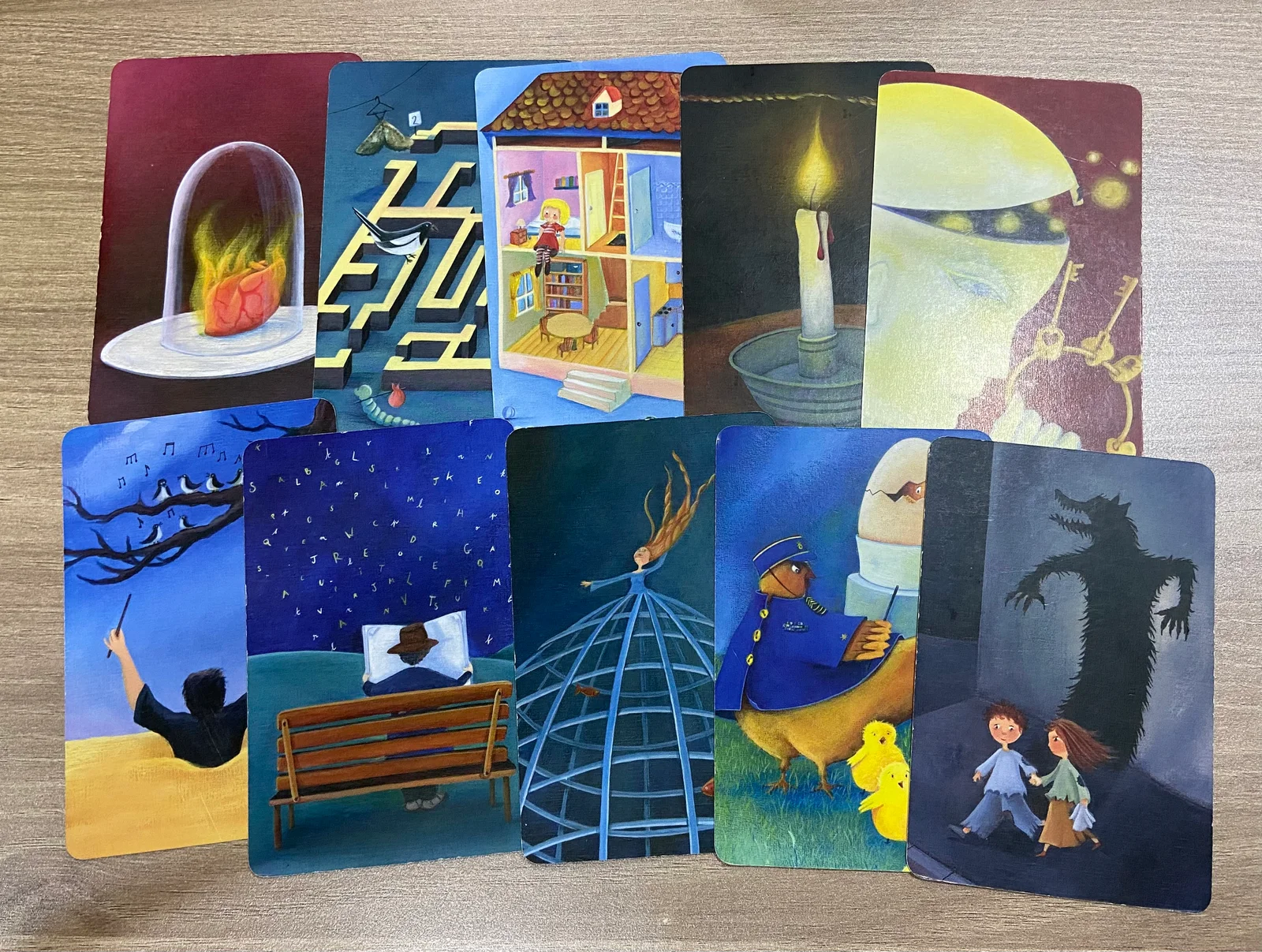
That difficulty led me to a simple method, one that can help us reflect on these questions. I confess I "stole" it from a mentor, after seeing her use imaginative cards to pray on her Instagram story post. I already owned a set of those cards. I did not know exactly how she used them in prayer, but I began to try them in my own context, in the way that came to me.
They are cards filled with imaginative pictures — certainly not tarot cards. They belong to a board game. I use them for prayer, where I have invited people I pray with to reflect on their lives through the cards they are drawn to, the ones that quietly catch them.
The cards help them find what is hidden between the lines of their own experience, so that what was buried can be found, and what was veiled can be uncovered. Because these cards are used in prayer, I believe it is the Holy Spirit who does the uncovering — showing them what God wants them to see about their lives, about the struggles they carry, about perception of God that they have, and about the future in front of them. This simple method can open a dimension of life that has long been buried and untouched.
Meister Eckhart said something important related to this:
The eye through which I see God is the same eye through which God sees me; my eye and God's eye are one eye, one seeing, one knowing, one love.
Seeing is never one-directional. When we look at an image in prayer, we are also being looked at.
One Card, Three Voices
Out of all my experiences leading creative prayer with these imaginative cards, one card has held my attention — because that single card spoke to three different people in three completely different ways.
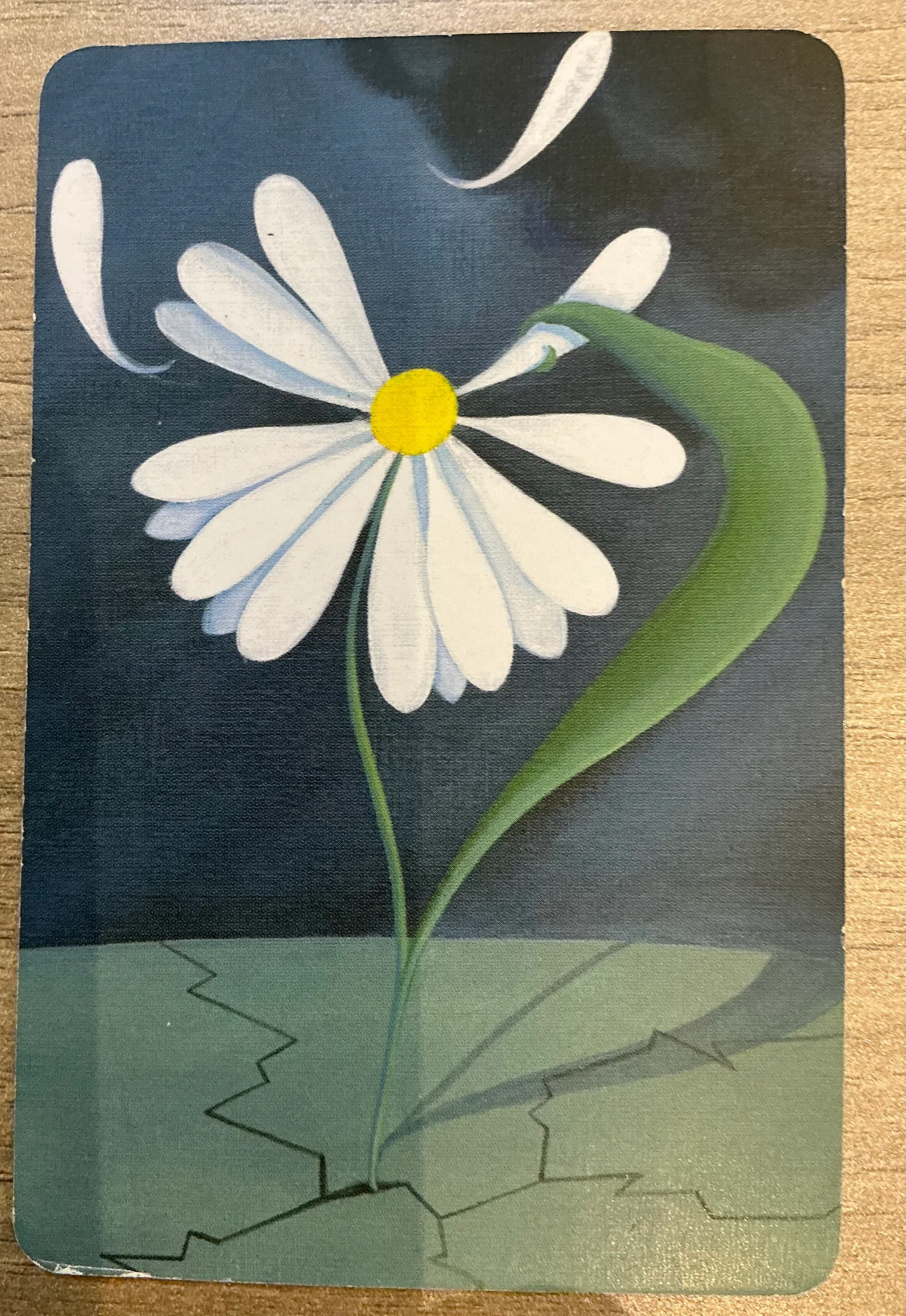
The first person focused on the cracked, dry ground and the dark clouds above it, reading the clouds as a sign of coming rain, the solution to the drought below. It led this person to trust that God will surely bring a way out, even by a paradoxical route — through the dark cloud, which we usually take as a symbol of gloom.
The second person focused on the dry ground and on the beauty that still rises out of hardship and difficulty — a flower blooming in a cracked land. It moved this person to see that God brings beauty into the world through his vulnerability.
**The third person, **in the different time, was no less striking. He also saw the dark clouds as a sign of rain about to fall, the answer to the drought. But he noticed something else: the plant is impatient. Its own leaf is reaching up to tear off its own crown of petals, wounding and destroying itself just before the rain arrives. God spoke to him about patience, in the middle of the great problem he was carrying.
One image opened many reflections, many dimensions. The Holy Spirit seemed to dance inside the creative space, the free and open space, of a person who had opened his heart to sit still in God's presence. As Jesus said of the Spirit, the wind blows where it wishes — and so does the Spirit, through an ordinary painted card on a table.
Not a New Method
This is not a new method. The same approach is used in Visio Divina, the practice of listening to God through an image or a painting, usually a painting of a biblical scene.
But using imaginative images with the steps of Visio Divina gives us a confirmation: the Holy Spirit can work and speak not only through the stories of Scripture, but through ordinary, creative images — images that sit very close to the life of modern people today.
**Ignatius of Loyola **built an entire spirituality on this conviction: “Finding God in all things.” Not in sacred things only. In all things.
The Real Secret Is the Gaze
What makes Visio Divina and creative prayer with imaginative cards so effective is not, in the end, the method. Nor is it the image being used. It is the language — or more precisely, **the gaze **we bring to the image.
That gaze is what Spiritual writers call the contemplative gaze.
So, what is contemplation?
I will take that up in my next article.