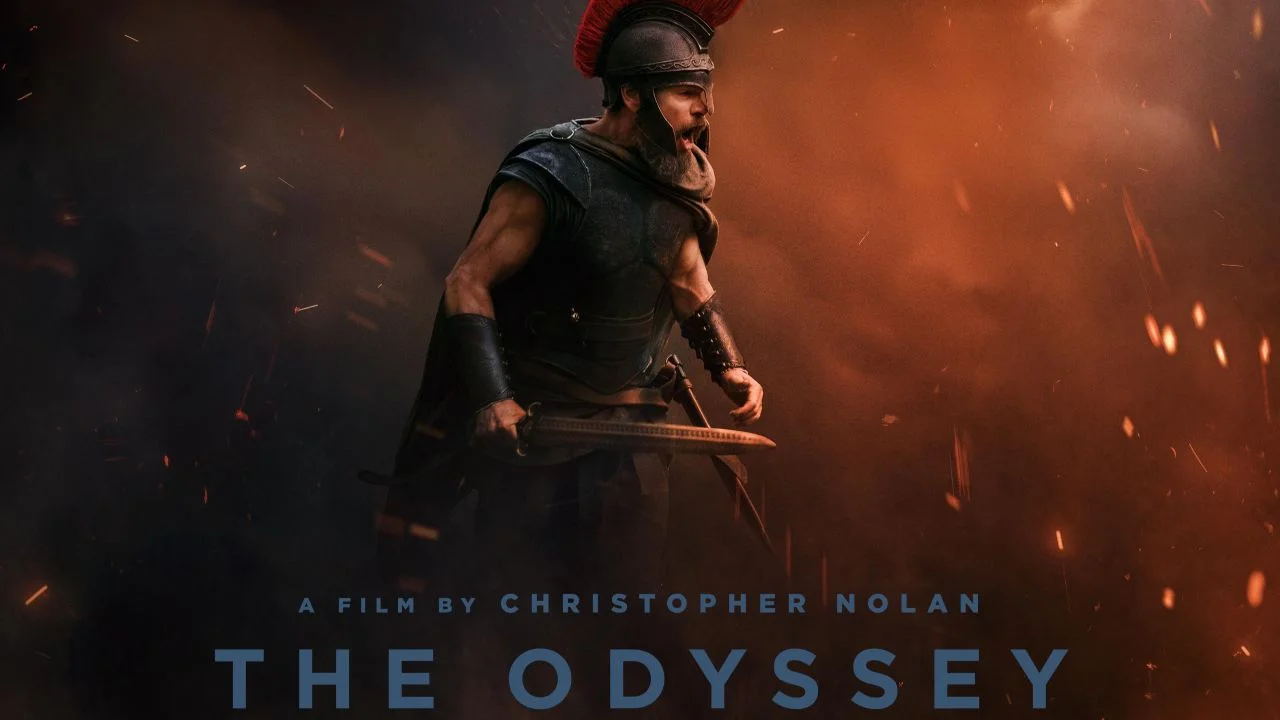
This year 2026, Christopher Nolan gave us his version of Homer’s ancient story, The Odyssey. Matt Damon plays Odysseus, the king of Ithaca, who is trying to sail home after the long war at Troy. The journey is hard. He faces storms, monsters, and gods who seem to work against him. But Nolan is not only interested in sea battles and giants. Under all the action, he asks a quieter question: what does it mean to remember who you are, and to keep wanting to go home?
The Lotus Scene
One of the film’s most striking moments comes with the lotus flower. In Homer’s old poem, the lotus is a small side story: Odysseus’ men eat a strange fruit on an island and forget their desire to return home, until he drags them back to the ship. Nolan changes this. In the film, it is Calypso (Charlize Theron) who feeds the lotus to Odysseus himself. She does not seem cruel at first. She wants to help him forget his pain. But the fruit does more than ease his wounds. It takes away his memory of home, his family, and even his own name for seven years. And for a long stretch of the story, he stays there, held not by chains but by sweet forgetting.
For a stretch of his wandering, Odysseus lingers in a drugged forgetfulness, fed just enough numbness to keep him from remembering who he is or what he has done. He is reluctant, even, to wake. It is one of the film’s most honest images of the human condition: we are anesthetized, and we half-prefer it.
The desert fathers called the antidote nepsis — wakefulness, watchfulness, sobriety of soul. Thomas Keating put it plainly: most of us are asleep, and prayer is our slow consent to wake up. The Greek word metanoia, which we translate flatly as “repentance,” really means the turning of a mind that has come to. And the church’s word for the deepest kind of remembering — anamnesis — is what we do at the Table: we remember, and in remembering, we are made present to the One who saves.
The lotus is always on offer. Distraction, numbing, the endless scroll — a thousand small forgetfulnesses that keep us pleasantly unhomed. Contemplative living is the daily refusal of the lotus. It is choosing to remember who and whose we are.
G. I. Gurdjieff: We Live in Sleep
The twentieth-century teacher G.I. Gurdjieff diagnosed this with unsettling bluntness. “A modern man lives in sleep, in sleep he is born and in sleep he dies,” he said — insisting that what we call ordinary waking life is in truth a kind of walking sleep, a mechanical existence we merely mistake for being awake. We eat, work, quarrel, and scroll on automatic, rarely present to our own lives. The deepest human problem is not so much that we are wicked as that we are asleep.
This is a hard word, but an honest one. It is easy to go through a whole day and never really be there for it. We move from one screen to the next, one task to the next, and the hours slip by. We are busy, but we are not awake. Like Odysseus on Calypso’s island, we can be alive and still forget who we are.
Why Contemplative Living Matters
This is why contemplative living matters. It is not about escaping the world or sitting still all day. It is about waking up inside the ordinary hours of our lives. It is the slow, patient practice of coming back to God, again and again, when we notice we have drifted off to sleep.
Every time we pause to pray, to breathe, to be silent before God, we are refusing the lotus. We are saying no to the numbness that wants to swallow us. We are choosing, in a small and daily way, to remember. And each act of remembering brings us a little closer to home — to God, to our true self, and to the people we are called to love.
Odysseus finally wakes and finds his way back to Ithaca. That is the hope held out to us too. We are not meant to sleep through our lives. We are made to wake up, to remember, and to come home.